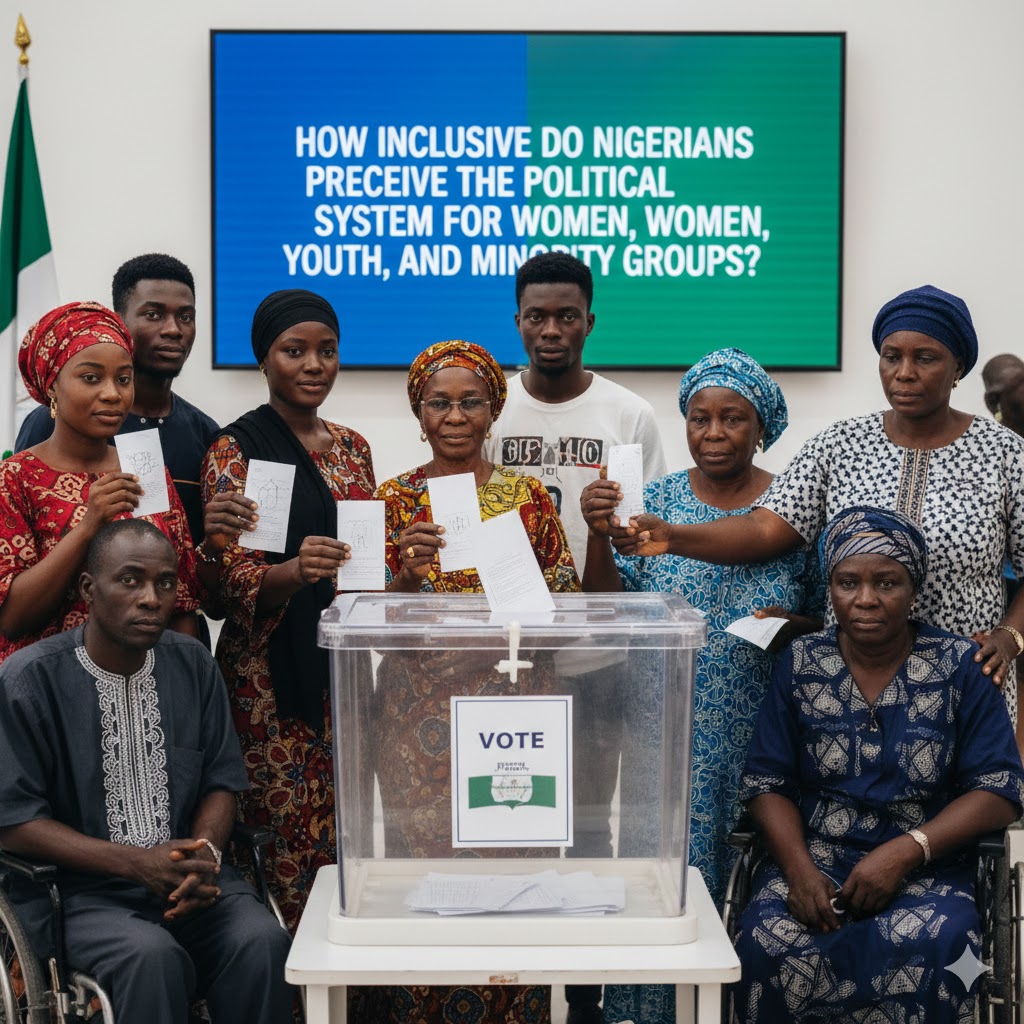
How Inclusive Do Nigerians Perceive the Political System for Women, Youth, and Minority Groups?
Inclusive governance is a cornerstone of a healthy democracy, ensuring that all segments of society—regardless of gender, age, ethnicity, or social background—can participate meaningfully in decision-making processes. In Nigeria, despite constitutional guarantees for equality and representation, debates continue about whether women, youth, and minority groups are adequately represented and empowered in the political system.
This poll seeks to measure Nigerians’ perceptions of political inclusivity, focusing on three key groups: women, youth, and minority communities. It explores public opinion on whether these groups have equal access to political opportunities, whether their voices are considered in policy-making, and whether systemic barriers limit their participation.
The survey will examine:
Representation in political offices: How well Nigerians feel women, youth, and minorities are represented in local, state, and federal political institutions.
Participation in party politics: Perceptions of access to party leadership roles, candidacy opportunities, and decision-making influence.
Policy influence: Whether citizens believe these groups’ needs and priorities are adequately reflected in policy-making.
Barriers to inclusion: Identifying perceived challenges such as cultural norms, economic limitations, political patronage, or discrimination.
Public support for affirmative measures: How Nigerians view initiatives like gender quotas, youth representation programs, or minority empowerment policies.
By gathering opinions across age groups, genders, regions, and socio-economic backgrounds, this poll will provide a comprehensive understanding of inclusivity perceptions in Nigeria’s political system. The results will offer valuable insights for policymakers, civil society organizations, advocacy groups, and political parties seeking to enhance representation, promote equitable governance, and strengthen democratic participation.
Participation in this poll is voluntary, and responses will be used exclusively for research, civic engagement analysis, and policy dialogue purposes. The aim is to contribute constructively to conversations about inclusive governance and the empowerment of underrepresented groups in Nigeria’s political landscape.
Important Notice
This poll is conducted solely for research, public opinion analysis, and civic engagement purposes. It does not represent the official position of any government institution, political party, or advocacy organization in Nigeria.
The responses reflect the personal opinions and perceptions of participants at the time of participation and should not be interpreted as verified facts, official assessments, or legal conclusions regarding political representation or inclusivity.
Participation is voluntary, and responses are collected anonymously unless otherwise stated. The organizers do not endorse or oppose any political party, candidate, or policy. The purpose of this poll is to provide insights into public perceptions of inclusivity for women, youth, and minority groups in Nigeria’s political system and to inform constructive dialogue on governance and representation.
Comments (0)
Poll Creator

Ikechukwu Anaekwe
Client
Poll Statistics
0
Polling Settings
Regulations
Voting Security
Results Visibility
Related Polls
Rotimi Amaechi in Focus: Which Leadership Qualities Are His Strengths and Which Are Weaknesses?
Peter Obi in 2027: What Are His Key Strengths and Weaknesses According to Nigerians?
Peter Obi’s Electability in 2027: Has His Popularity Increased or Declined Since 2023?
What Do Nigerians See as President Tinubu’s Key Strengths and Weaknesses?
No comments yet. Be the first to share your thoughts!