Polls are powerful tools for understanding public opinion, predicting outcomes, and guiding decisions in politics, business, research, and media. From election forecasts to customer satisfaction surveys, polling results often influence major decisions.
However, one critical factor determines whether a poll is trustworthy or misleading: sample size.
Many people assume that a larger sample automatically guarantees accuracy, while a small sample makes a poll useless. The reality is more nuanced. Sample size affects poll accuracy in measurable ways, but it is not the only factor that matters.
This article explains how sample size influences poll accuracy, why it matters, how it interacts with margin of error, and what poll readers should look for when interpreting results.
What Is Sample Size in Polling?
Sample size refers to the number of individuals surveyed in a poll. Instead of asking everyone in a population—such as all voters in Nigeria or all customers of a brand—pollsters select a smaller group (the sample) that is meant to represent the larger population.
For example:
A national political poll might survey 1,200 voters.
A local opinion poll might survey 400 residents.
An online quick poll might survey only 100 people.
The key question is whether that sample is large enough and representative enough to reflect the views of the whole population accurately.
Why Sample Size Matters for Poll Accuracy
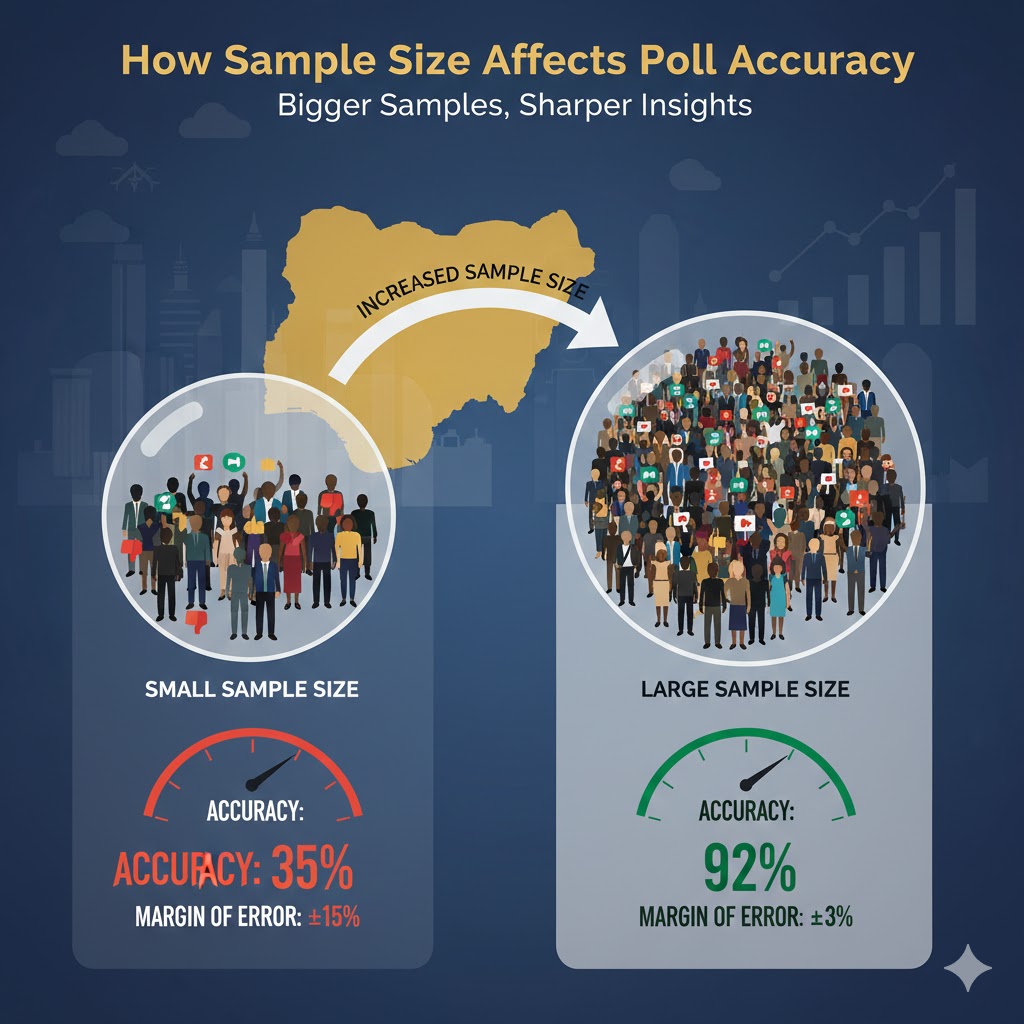
Sample size directly affects statistical reliability. When more people are included in a poll, random fluctuations decrease, and the results become more stable. Smaller samples, on the other hand, are more vulnerable to chance variation.
Imagine flipping a coin:
Flip it 10 times, and you might get 7 heads.
Flip it 1,000 times, and the result will be much closer to 50% heads and 50% tails.
Polling works in a similar way. Larger samples tend to produce results that are closer to the true opinion of the population.
Sample Size and Margin of Error Explained
The relationship between sample size and accuracy is best understood through the margin of error.
The margin of error tells us how much the poll result could differ from the true population value. It is usually expressed as “±X%.”
For example:
A poll showing 55% support with a ±3% margin of error means true support could be between 52% and 58%.
How Sample Size Affects Margin of Error
Small sample (100 respondents): Margin of error ≈ ±10%
Medium sample (400 respondents): Margin of error ≈ ±5%
Large sample (1,000 respondents): Margin of error ≈ ±3%
Very large sample (2,000+ respondents): Margin of error ≈ ±2%
As sample size increases, the margin of error decreases—but with diminishing returns. Doubling a sample size does not halve the margin of error. This is why many professional polls settle around 1,000 to 1,500 respondents.
Is Bigger Always Better?
Not necessarily.
While larger samples reduce random error, they do not fix poor polling design. A large but biased sample can still produce inaccurate results.
For example:
A poll of 10,000 people conducted only on social media may overrepresent young users.
A phone poll conducted only during working hours may miss working-class respondents.
In such cases, a smaller but well-designed and representative sample can be more accurate than a massive but flawed one.
Sample Size vs Representativeness
One of the most misunderstood aspects of polling is the difference between sample size and representativeness.
Sample size answers: “How many people were surveyed?”
Representativeness answers: “Do these people reflect the population?”
A poll of 500 carefully selected respondents that matches the population’s age, gender, region, education, and income distribution can outperform a poll of 5,000 respondents drawn randomly from a biased source.
Professional pollsters use techniques such as:
Stratified sampling
Weighting responses
Demographic quotas
These methods help ensure that the sample mirrors the real population, even when the sample size is modest.
Common Misconceptions About Sample Size
“Online polls are accurate if they have many votes”
Not true. Online polls often suffer from self-selection bias. People who choose to vote may have stronger opinions than the general population, regardless of how many participate.
“Small polls are useless”
Also not true. Small polls can still be valuable for:
Tracking trends over time
Understanding niche groups
Exploratory research
However, their results should be interpreted with caution and wider margins of error.
“One poll tells the whole story”
Even with a large sample, a single poll is only a snapshot. Poll averages and repeated surveys are usually more reliable indicators of public opinion.
How Sample Size Affects Election Polls
In political polling, sample size plays a major role in credibility. Most national election polls survey between 1,000 and 2,000 likely voters. At this level:
The margin of error is usually around ±2–3%.
Differences smaller than the margin of error are statistically insignificant.
This explains why two candidates polling at 49% and 51% are often described as “statistically tied,” even though one appears ahead.
Smaller regional or constituency polls may use fewer respondents due to cost, but their results must be interpreted more cautiously.
Business and Market Research Polls
In market research, ideal sample size depends on:
Target market size
Budget constraints
Decision risk
For example:
A startup testing a product idea may use 200–300 responses.
A multinational launching a new product may require thousands of responses across regions.
The higher the financial or reputational risk, the more important it is to use a sufficiently large and representative sample.
Practical Guidelines for Interpreting Poll Sample Size
When reading or sharing poll results, ask these questions:
How many people were surveyed?
What is the margin of error?
Who conducted the poll?
How were respondents selected?
Does the sample reflect the population being discussed?
If a poll does not clearly state its sample size and methodology, its accuracy should be questioned.
Sample size is a cornerstone of poll accuracy, but it is not the only factor that matters. Larger samples generally reduce margin of error and increase reliability, but representativeness, methodology, and transparency are equally important.
A well-designed poll with 1,000 respondents can provide remarkably accurate insights into public opinion, while a poorly designed poll with tens of thousands of responses can still mislead. Understanding how sample size affects accuracy helps readers become more informed consumers of polls—and better decision-makers in a data-driven world.
How Sample Size Affects Poll Accuracy
General
General
Ikechukwu Anaekwe
February 07, 2026
6 min read
0 Shares
Latest Polls

Latest Datasets
No datasets available yet.
Related Posts in General

Free survey tool for Nigerian businesses
In today’s competitive Nigerian market, data is no longer optional — it is e...
Ojo-Olayinka Foluwasomi
Mar 02, 2026
Political Polling in Nigeria: Methods, Accuracy & Trends
Political polling has become an essential part of democratic societies, providin...
Ojo-Olayinka Foluwasomi
Mar 02, 2026

The Future of Digital Voting & Online Polling in Nigeria
The rise of digital technology has transformed the way people interact, share op...
Ojo-Olayinka Foluwasomi
Mar 02, 2026

How Businesses Can Use Opinion Polls to Grow in Nigeria.
In today’s digital era, businesses in Nigeria face an increasingly competitive...
Ojo-Olayinka Foluwasomi
Mar 02, 2026

How to Create Viral Polls That Nigerians Love to Vote On
Creating viral polls that Nigerians love to vote on is both an art and a science...
Ojo-Olayinka Foluwasomi
Mar 02, 2026


Comments (0)
No comments yet. Be the first to comment!